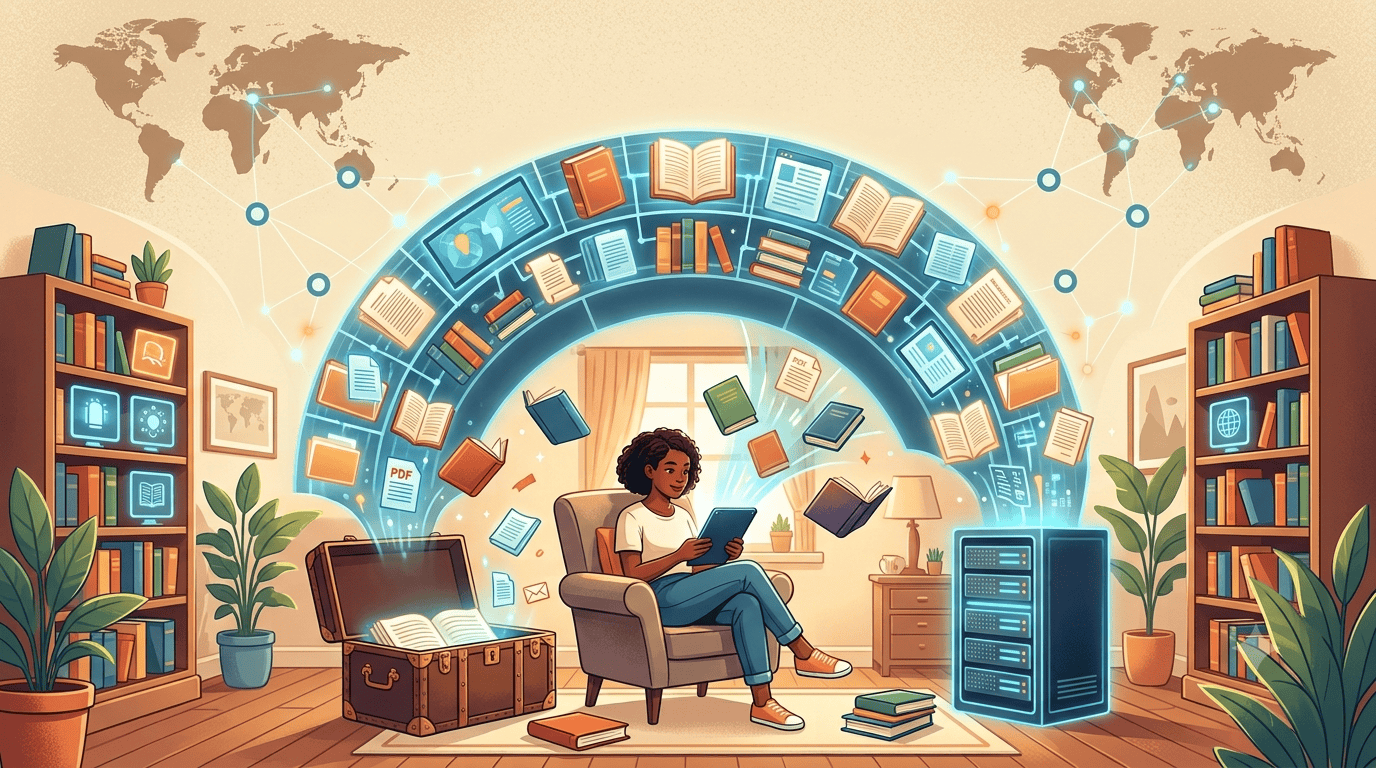
Beyond Google: 10 Hidden Open Libraries Every Reader & Student Needs to know.
Let’s be honest: books and high-quality information are getting expensive. Pricier paperbacks, monthly audiobooks subscriptions, and $40 academic paywalls to read a 10 pages research paper can make learning feel like a luxury sport.
But here is the kept secret of the internet, world’s largest collection of human knowledge at your fingertips, 100% legal, and completely free. No premium subscription, a fancy university login, or a sketchy download site to access it.
1- For the Avid Reader: Classics, History and Everyday Reads
If you can’t imagine evening or long-distance journey without a book in your hand, you don’t need to hand over your credit card.
The following platforms are the best at bringing these everyday reads straight to your screen, beautifully packaged and legally free.
Project Gutenberg: The Grandfather of Digital Libraries
If you’ve ever downloaded a free classic book online, you probably have Project Gutenberg to thank. Founded way back in 1971, it is the oldest digital library in existence and currently hosts over 75,000 free eBooks.
- What it’s best for: Finding virtually any literary classic you can think of from Moby Dick and Romeo and Juliet to Edgar Allan Poe’s complete poetry you can find as well history books and if you happen to know more than one language there is a plenty of non English books like Spanish, German and more.
- The Vibe: It’s a simple, volunteer-run archive. You don’t need an account or an app; you just search for a book, download it in
.epubformat (also available other formats and older devices), and start reading you can also send the book to your Dropbox or Google Cloud.
Standard Ebooks: The High-Aesthetic Alternative
As amazing as Project Gutenberg is, its books can sometimes look a bit… messy. Because they are processed by automated software, you might run into weird spacing, ugly typography, or generic covers. Enter Standard Ebooks.
- What it’s best for: Readers who care about a premium reading experience. This brilliant volunteer project takes public domain texts from sites like Project Gutenberg and completely redesigns them. They format the text to professional typography standards, clean up the code, and give every single book a gorgeous cover using classical artwork.
- The Vibe: It feels exactly like buying a beautiful, curated modern edition from a high-end bookstore, except the price tag is zero.
Open Library: Your Neighborhood Library, Gone Global
What if you want to read something a bit more modern? That’s where the Open Library comes in. Run by the non-profit Internet Archive, its goal is to create a web page for every book ever published.
- What it’s best for: Borrowing books that aren’t in the public domain yet. They have scanned over 3 million physical books, and you can digitally “check them out” one at a time to read in your browser or e-reader app.
- The Vibe: Perfect for catching up on 20th-century fiction, specialized biographies, or out-of-print books you can’t find anywhere else.
LibriVox: The Audiobook Sandbox
If you prefer to listen to Audiobooks while doing the dishes, commuting, or working out, LibriVox is a goldmine.
- What it’s best for: Free, legally recorded audiobooks. Volunteers from all across the globe record chapters of public domain books, making them available as free audio downloads or podcasts.
- The Vibe: Because they are read by volunteers, the narration quality can vary from chapter to chapter, but it’s an incredible, community-driven resource for reading on the go.
Quick Tip:If you’re downloading books from Project Gutenberg or Standard Ebooks to read on a Kindle, always look for the EPUB format. Amazon allows you to send
.epubfiles directly to your Kindle device or app using their “Send to Kindle” webpage, making it incredibly easy to sync your free library across all your screens.
2. For the Student and Researcher: Bypassing the Academic Paywall
If you’ve ever tried to do deep research for a university essay, a passion project, or a work report, you’ve probably hit the dreaded academic paywall. You find the perfect article, click the link, and a pop-up appears demanding $35 to read a 12-page PDF. It’s deeply frustrating, especially since most of that research was funded by public tax dollars.
Thankfully, the academic world is undergoing a massive shift called the Open Access movement. A growing community of scientists, universities, and researchers believe that human knowledge shouldn’t be locked behind a corporate credit card.
The following platforms are your legal master keys to bypassing those paywalls and accessing elite, peer-reviewed data for absolutely zero dollars.
CORE: The Ultimate Search Engine of Academic open research papers
Think of CORE as Google Scholar’s open-access cousin, but with a superpower: it only shows you things you can actually read right now. Run by The Open University in the UK, CORE crawls thousands of open-access journals, research papers and university repositories from around the globe.
- What it’s best for: Finding full-text research papers across every subject imaginable from psychology and economics to history and literature. CORE currently contains 449M open access articles collected from 15K data providers around the world.
- The Vibe: Incredibly efficient. When you search for a topic, CORE searches the data vaults of thousands of universities simultaneously. If a researcher somewhere in the world uploaded a free legal copy of their study to their university’s network, CORE will find it and give you a direct download link to the PDF.
arXiv: The Gold Standard for Tech and STEM
Pronounced “archive” (the ‘X’ represents the Greek letter Chi), this massive platform is hosted by Cornell University and has been the beating heart of the scientific community since 1991.
- What it’s best for: Cutting-edge research in hard sciences specifically physics, mathematics, computer science, quantitative biology, and artificial intelligence.
- The Vibe: Fast-paced and highly technical. In fields like AI, traditional academic publishing takes too long; by the time a paper prints in a journal, the technology has already changed. Instead, scientists upload their “pre-prints” (the final, reviewed version of their paper before formal publication) directly to arXiv. If you want to read the foundational papers that built tools like ChatGPT or quantum computing, they are all hosted here for free.
DOAB: The Textbook Megastore
While CORE and arXiv are fantastic for short research papers and journal articles, sometimes you need a broader overview. You need an entire textbook. That is where the DOAB (Directory of Open Access Books) comes in.
- What it’s best for: Finding full-length, peer-reviewed academic textbooks and scholarly monographs entirely for free. It indexes tens of thousands of academic books from hundreds of reputable university presses and help you to find trusted open access book publishers.
- The Vibe: A digital academic bookstore where everything is free. It’s brilliant for looking up full-scale histories, comprehensive sociology textbooks, or deep scientific overviews without having to drop $150 at a college bookstore.
Smart Research Tip: When citing open-access papers found on these platforms for a school or work project, look for the DOI (Digital Object Identifier) usually listed on the first page. A DOI is a permanent, unique link that ensures your teacher or supervisor can find the exact paper you used, even if the website’s URL changes in the future.
DOAJ: Directory of Open Access Journals
Need academic journal articles?
DOAJ provides thousands of free, peer-reviewed journals across disciplines.
What it’s best for:I you are and independent researcher or you are writing academic papers and you don’t have university access this is you go to directory.
The Vibe: Similar brilliant concept of DOAB for academic journal articles.
3. For the History and Nature Lovers: Cultural Heritage Archives
Sometimes, reading isn’t just about absorbing text it’s about stepping into a time machine. If you want to flip through medieval manuscripts, view historical maps, or gaze at centuries-old botanical artwork, the internet has preserved these treasures in stunning high-definition.
The following archives are dedicated to protecting global history and making it accessible to anyone with an internet connection.
The Internet Archive: The Vault of Everything
Think of The Internet Archive as the digital equivalent of the ancient Library of Alexandria, except it never burns down. This massive non-profit library is famous for its “Wayback Machine” (which takes snapshots of deleted webpages), but its collections run far deeper than that.
- What it’s best for: A chaotic, wonderful mix of everything. It hosts over 44 million books and texts, but it also preserves millions of hours of historical audio (like old-time radio shows and live concerts), public domain movies, and software.
- The Vibe: Pure nostalgia and discovery. Want to play a pixelated MS-DOS computer game from 1988 right inside your browser? Or read an original, scanned diary of a soldier from the American Civil War? This is where you go to get lost for hours.
The Biodiversity Heritage Library (BHL): Nature’s Time Machine
If you have a soft spot for natural history, wildlife, or vintage scientific art, the Biodiversity Heritage Library is one of the most beautiful corners of the internet. A global consortium of natural history museums, botanical gardens, and research institutions teamed up to digitize their physical vaults.
- What it’s best for: Millions of pages of historic scientific literature dating back to the 15th century, combined with an unparalleled collection of hand-painted botanical illustrations, wildlife sketches, and early maps of the natural world.
- The Vibe: High-art meets deep science. It is an incredible resource for designers looking for public-domain vintage art, or anyone wanting to see how early explorers documented the world’s ecosystems.
Conclusion: Knowledge Shouldn’t Be a Luxury
Access to high-quality information, timeless literature, and cutting-edge science shouldn’t be reserved only for those who can afford steep monthly subscriptions or expensive university tuitions. The open-access digital libraries we’ve covered prove that the doors to global knowledge are wide open you just need to know which links to click.
Whether you’re downloading a flawlessly formatted classic from Standard Ebooks, digging into a dataset on arXiv, or exploring the depths of history on the Internet Archive, your digital bookshelf is officially limitless.
💡 The Ultimate “Secret Weapon” Pro Tip: Libby
While the open libraries above are incredible for historical works, classics, and research, what if you want to read a modern, copyrighted New York Times bestseller that came out last month?
Enter Libby (by OverDrive). If you have a library card from your local public library (or a university ID), you can download the free Libby app on your phone or tablet. It connects directly to your local library’s digital catalog, allowing you to legally browse, borrow, and read modern eBooks and audiobooks entirely for free. You can even stream them directly to your Kindle device. It’s the perfect way to support your local library system while keeping your reading habit completely free.
Now it’s your turn: Which of these digital libraries are you going to bookmark first? Do you have a favorite free reading resource that we missed? Let us know in the comments below!